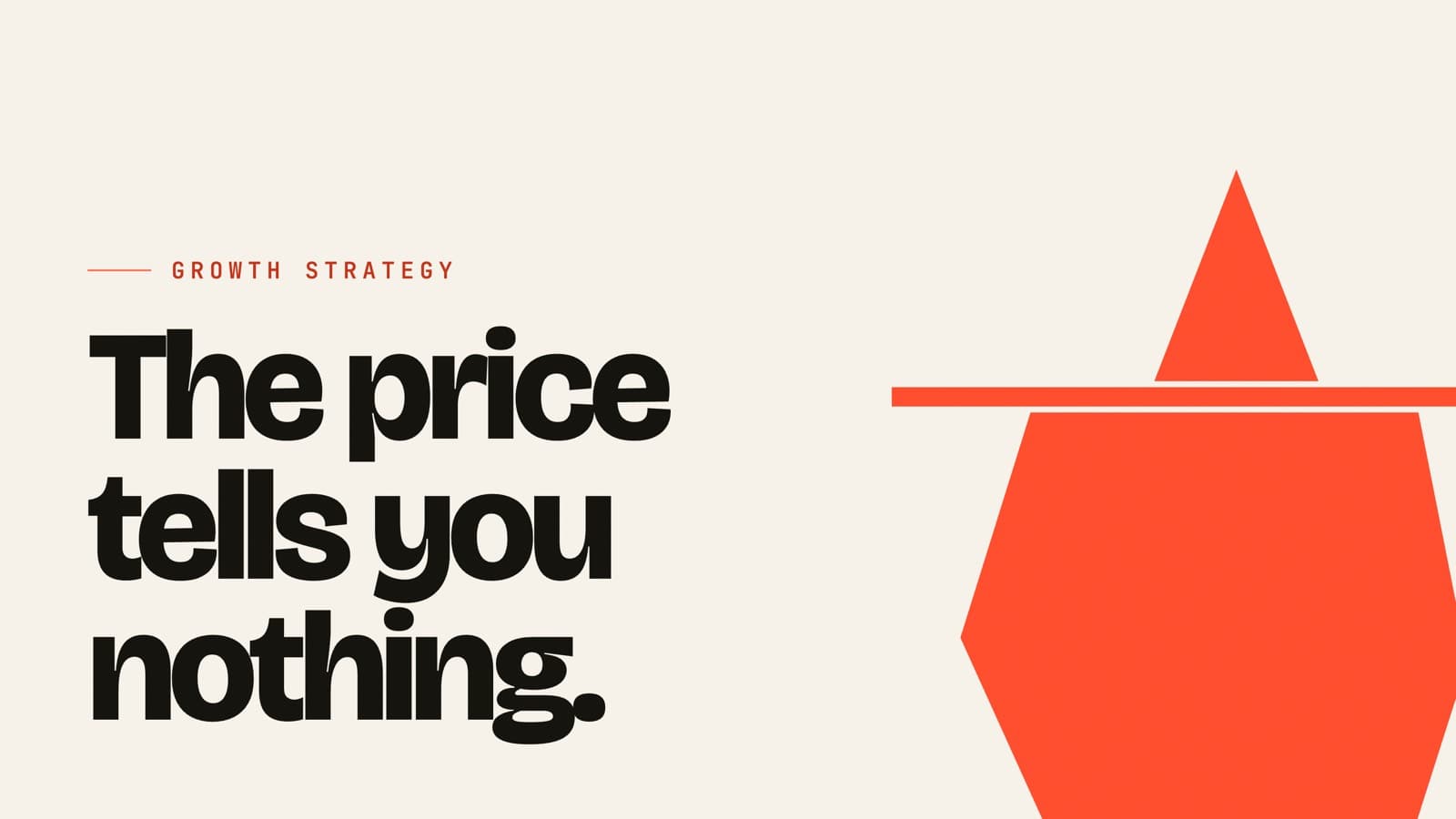
Cover poster on warm paper. Large type reads "The price tells you nothing." beside a coral iceberg whose small tip above the waterline is dwarfed by the mass below.
Website price ranges are enormous because the word "website" covers everything from a digital business card to a revenue system. Judge the investment by what it returns, not by the quote.
- The same brief can return quotes from a few hundred pounds to tens of thousands because "a website" describes the output, not the job it is built to do.
- You are really paying for three things: whether it can be found, whether it converts, and whether it lasts. A cheap site usually skips all three.
- Set the budget from the value of a single customer, not from a number you picked first. A site that wins two extra jobs a month has already paid for itself.
The first question almost every business asks a web designer is "how much?". It is the natural question and it is the wrong one to ask first, because the answer is genuinely useless without context. Send the exact same one-paragraph brief to ten providers and you will get quotes from a few hundred pounds to tens of thousands. None of them is lying. They are quoting for completely different things that happen to share the word "website".
A website can mean a template with your logo dropped into it, finished in an afternoon. It can also mean a researched, designed, written and engineered system built to be found on Google, to turn visitors into enquiries, and to keep working for years. Both are "a website". Asking what one costs without saying which one you mean is like asking what a vehicle costs. A used scooter and a delivery van are both vehicles, and the price tells you almost nothing until you say what you need it to carry.
The three things you are actually paying for
Strip away the jargon and every website quote is really pricing three jobs. Cheap quotes are cheap because they quietly skip one, two, or all three of them. Knowing what they are lets you read any quote properly.
1. Whether it can be found
A site that looks lovely and ranks for nothing is a brochure you have to hand out yourself. Being found means the technical foundations are right (speed, structure, mobile, indexability) and the pages are built around what your customers actually search for. This is invisible work. It does not show up in a screenshot, which is exactly why the cheapest builds leave it out. You only notice it is missing months later, when the site brings in no enquiries on its own.
2. Whether it converts
Traffic that arrives and leaves without doing anything is worthless. Conversion is the difference between a visitor reading about you and a visitor contacting you, and small technical details move it more than most founders expect. In 2020, Google and Deloitte Digital published 'Milliseconds Make Millions', a study of 30 million user sessions across 37 retail, travel and luxury brands. They found that improving mobile site speed by just one tenth of a second lifted retail conversions by 8.4% and average order value by 9.2%. A tenth of a second. That is the kind of margin a well-built site captures and a cheap one leaves on the table.
3. Whether it lasts
A site built on shaky foundations is a recurring cost disguised as a one-off saving. If you cannot edit it without paying the developer, if it breaks when a browser updates, or if it has to be rebuilt in eighteen months, the cheap quote was never cheap. It was a deposit on a second project. Durable builds cost more up front and less over their life, which is the only timescale that actually matters.
Cost versus investment: the distinction that changes everything
A cost is money that leaves and does not come back. An investment is money that returns more than it took. The reason the same site can be either is that your website is usually the first real impression a buyer gets of you, and first impressions price you. Research from Stanford University's Web Credibility Project, led by the psychologist B.J. Fogg, found that 75% of people judge a company's credibility based on the design of its website. Three in four. If your site looks cheap, a meaningful share of your market quietly decides you are cheap, and prices you accordingly, before you ever speak to them.
That is the hidden cost of the bargain build. It is not just that it converts less. It is that it caps what you can charge, because it sets the buyer's expectation of you at the door. A premium site does the opposite. It gives you permission to quote premium prices, and that single shift usually dwarfs the difference between the cheap quote and the good one.
How to set a budget that makes sense
Do not start with a number you are comfortable with. Start with the value of one customer. Work out what a single new client is worth to you over the time you keep them. Then ask how many extra ones the site needs to win to pay for itself. For most service businesses the honest answer is small. If a good website brings in two extra jobs a month that you would otherwise have lost to a competitor who looked more credible, almost any sensible build has paid for itself inside a quarter and is pure return after that.
That reframing is the whole game. The question was never "what does a website cost". It is "what does the right website return, and how quickly". Answer that, and the price stops being a number you flinch at and becomes a number you can judge.
Get a straight answer on what your project needs
A free 30-minute call. We map exactly what your site has to do to pay for itself, and what it would take to get there. No slides, no pressure, just a clear number and the reasoning behind it.
Book a Free Project Call ↗︎More from the journal.
 01
01Why Most Marketing Spend Produces Nothing
Most budgets don't fail on channel or spend. They fail in the unowned gaps between acquisition, conversion, and follow-up.
 02
02Measuring What Matters: The Metrics That Actually Predict Revenue
Most dashboards measure activity, not outcomes. Four metrics actually predict revenue. The rest is decoration.